A B C D E F G H I J K L M N O P Q R S T U V W X Y Z
A
Actual Shelf Depth:The actual measured depth of a flat shelf from front to back.
ADA Compliant: Products that meet the guidelines specified by the Americans with Disabilities Act for access by disabled people.
B
Book Match: The most commonly used match in which every other piece of veneer is turned over so adjacent pieces are opened like adjacent pages in a book, creating a mirrored-image pattern at the joint line and yielding a nearly continuous grain.
Burl: An inconsistency in wood grain (such as a swirl or twist) that does not contain a knot, but usually occurs near one.
C
Catalyzed: In finishing, an ingredient added to a basic product to provide additional performance characteristics.
D
Double-Faced Shelving: Shelves accessible from both sides, usually placed perpendicular to a wall or freestanding.
G
Grain: The direction, size, arrangement and appearance of the fibers in wood or veneer. Appearance varies with both the species and the cut.
H
Half Round: A method of cutting veneers on an off-center lathe that results in modified characteristics of both rotary and plain sliced veneers.
Hardwood: Wood usually obtained from deciduous trees. The term does not refer to the specific density or resistance to wear and abuse.
High Pressure Laminate (HPL): A thick, durable laminate made from layers of paper and resin, molded and cured under high pressure.
K
Kiln-dried: Lumber dried in a closed chamber in which the removal of moisture is controlled by artificial heat and usually by relative humidity.
L
Laminate: Material made of thin sheets of paper bonded with plastic resins and used on the surfaces of desks, tables, shelving, study carrels, etc.
M
Melamine: In furniture: a resin made from the organic base, melamine, to make a thin laminate.
MDF: Medium density fiberboard; made from compressed particles of wood and used in the construction of furniture.
Mortise: A cavity made to receive a lock or other hardware.
Mortise-and-Tenon Joint: A carpentry joint formed by inserting a tab or tenon into a closely fitting slot or mortise. Dovetailing is one variation.
N
Nominal Shelf Depth:
The depth of the book that would fit on a given flat shelf: on steel shelving the shelves hook onto a 2" deep frame, leaving a 2" gap between the backs of shelves. Therefore, a book 1" deeper than the actual shelf depth could be placed so that it would not overhang the front of the shelf.
P
Plain Sliced: Also flat sliced and plain sawn. Veneer sliced parallel to the pith of the log and approximately tangent to the growth rings to achieve flat cut veneer.
Premium Grade: The highest grade available in both materials and workmanship, intended for the finest work. This is naturally the most expensive grade.
Q
Quarter Slicing: Veneer produced by cutting in a radial direction to the pith to the extent that ray flake is produced, and the amount may be unlimited. Produces a striped grain pattern, straight in some woods, varied in others.
R
Random Match: Matching between adjacent veneer leaves on one panel face. Random selection in the arrangement of veneer leaves producing a deliberate mismatch between the pieces of veneer.
Rift Cut: Usually referring to veneers, this method is similar to Quarter Slicing, but accentuates the vertical grain and minimizes the "flake" of the finished material. Veneer produced by cutting at a slight right angle to the radial to produce a quartered appearance.
Rotary Slicing: The most common method for preparing veneers for softwood plywood in which the log is placed in a lathe and rotated against a stationary knife. This produces a continuous sheet of veneer.
Running Match: Each panel is assembled from as many veneer leaves as necessary. Any portion leftover from the last leaf may be used as the start if the next panel.
S
Single-Faced Shelving: Shelves accessible from one side only, usually placed along a wall.
Slip Match: Matching between adjacent veneer leaves on one panel face. Adjoining leaves of veneer are slipped out in sequence, with all the same face side being exposed.
Softwood: Wood that is usually obtained from coniferous trees. Doses not refer to the specific density or resistance to wear and abuse.
T
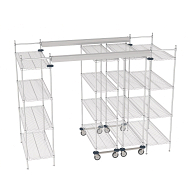
Transverse Brace: A metal channel fastened to the tops of steel shelving frames that connects all the shelves together so that no row can tip unless all the rows do. Commonly used in areas of greater seismic risk.
V
Veneer: A thin slice of higher-quality timber that is applied with glue to an inexpensive, secondary piece of timber. Used as an affordable substitute for solid hardwood.
Sources:
Wood Veneer by Arne Thomsson
Marshfield DoorSystems Inc. 2007. http://www.marshfielddoorsystems.com/Glossary_AB.html. Copyright 2007 Marshfield DoorSystems, Inc.
OakPlus Furniture. 2007. http://www.oakplus.com/glossary%20of%20terms.htm. Copyright 2001 OakPlus Furniture. |